The Seismic Shift in Store Lifecycle Management Technology from a Founder
How Artificial Intelligence Is Rewriting the Operational Rules of Retail Real Estate

By Joe Valeri, Founder & former CEO of Lucernex, Co-founder of Surfaice.pro, Chairman & Co-founder of Rendr.com.
The Limits of What We Built
For most of my career, I have lived at the intersection of retail real estate and technology — and for a long time, that intersection felt like the frontier. In the early 2000s, the industry was running on spreadsheets, fragmented databases on retired technology, and institutional memory stored almost entirely in people’s heads. Lease critical dates were tracked in Excel at best. Construction milestones lived in three-ring binders. CAM reconciliations arrived by mail and were reviewed, if at all, by whoever happened to have time.
The problem wasn’t that retailers didn’t care about their real estate operations. The problem was that no integrated system existed to manage them. So Mike Nuzum and I created Lucernex and our team built one. At Lucernex, we spent years developing what we came to call Store Lifecycle Management — a platform designed to centralize every dimension of the retail real estate function, from site selection through lease execution, construction management, facilities operations, and financial close-out. Along the way, we helped define what the industry now recognizes as the Integrated Workplace Management Systems (IWMS) category, a market that has since grown to approximately $5.1 billion globally and is projected to reach $14.8 billion by 2033.¹
If you would like to see detailed case studies on portfolio optimization and CAPEX spend decision making using AI, please click below:
These systems did something genuinely transformative. They gave retailers a single source of truth. Before digitization, the same lease might be interpreted three different ways by three different departments. After, that lease lived in one system — accessible to every team member who needed it, with data fields that connected to financial forecasting, facilities scheduling, and project tracking. The industry moved from chaos to coherence.
But here is what we could not solve, and what I have spent considerable time thinking about since: everything those systems knew, a human had to teach them. Explicitly. Field by field. If it wasn’t entered into a structured database, it effectively did not exist. Most data, in fact, lived in documents that the database only knew of as an attachment (at best).
That limitation turned out to be more consequential than anyone building those systems fully appreciated at the time.
The Dark Matter of Retail Real Estate
Walk into any retailer’s real estate department and you are likely to find two things. The first is a system of record — properly maintained, structured — containing the data the team has entered over years of disciplined work. The second, far less visible, is an enormous mass of unstructured information: tens of thousands of lease documents, construction contracts, email threads, vendor invoices, CAM reconciliation statements, RFIs, redlined PDFs, and negotiation histories stretching back decades.
This second category dwarfs the first. Industry researchers consistently estimate that roughly 80% of enterprise data is unstructured. In retail real estate specifically, the ratio may be even higher. A typical portfolio of 500 stores generates not just 500 leases but thousands of amendments, side letters, correspondence files, and related documents for each location. The contractual and historical intelligence embedded in those documents is vast. It is also, by conventional means, almost entirely inaccessible at scale.
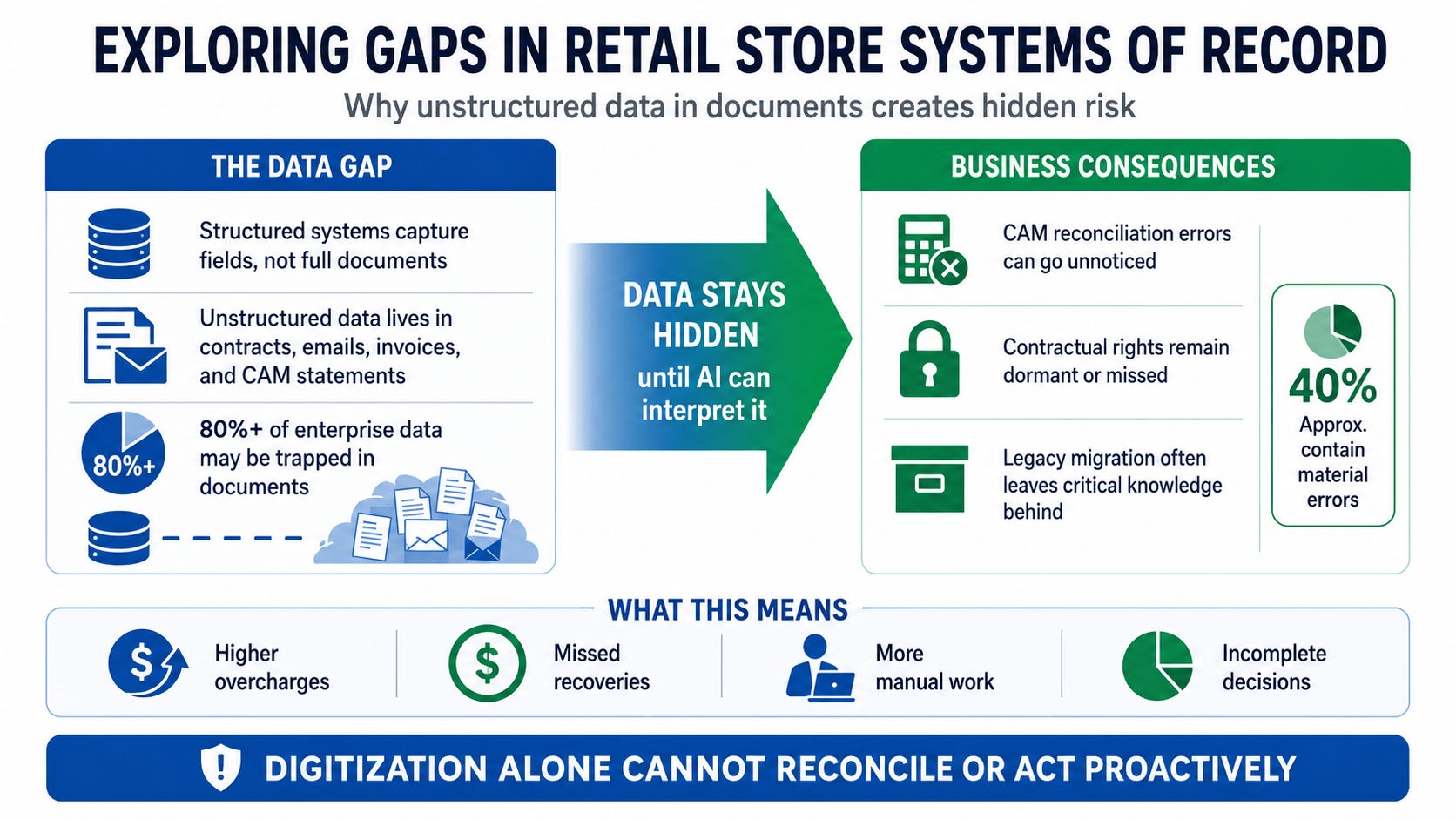
In 2023, approximately 40% of CAM reconciliations across U.S. retail portfolios contain material errors.²
The consequences are measurable. A 2023 analysis by PredictAP found that approximately 40% of CAM reconciliations across U.S. retail portfolios contain material errors.² The aggregate cost of those errors — through landlord overcharges, misapplied exclusions, and uncontested billings — generates an estimated $5 to $15 billion in annual friction costs across the industry.³ The average overcharged tenant pays between $9,000 and $12,000 more per year than their lease requires, and that overcharge compounds silently, year after year, unless someone happens to conduct a formal audit.
The word “happens” is doing a lot of work in that sentence. Because the reason these errors persist is not negligence — it is bandwidth. Lease administrators managing large portfolios simply cannot read every lease with the attention it deserves. Rights go unexercised. Clauses sit dormant. Obligations go unmatched against invoices. The contract exists, the obligation is clear, and the money still walks out the door.
This is the fundamental problem that digitization alone cannot solve. A system of record can store a co-tenancy clause. It cannot notice when the co-tenancy condition has been triggered. It can provide all the data needed to perform a CAM rec, but it cannot perform the reconciliation on its own, audit it and complete all required follow up tasks to recover all available funds.
There is a layer to this problem that most retailers don’t fully appreciate, and it traces back to how the current generation of systems was built. When modern platforms like Lucernex entered the market and displaced the previous generation of lease administration technology — systems like SLIM, REM, and Tequila — they inherited a structural decision that still shapes what retailers know about their own portfolios today.
During those migrations, organizations faced a choice: pay to have every lease fully re-abstracted from the original document, or simply migrate whatever data had already been captured in the legacy system. The vast majority chose the latter. It was faster, less expensive, and reasonable on its face. But those legacy systems, constrained by the technology and design philosophy of their era, had abstracted a fraction of what each lease actually contained. Critical clauses were left uncaptured. Nuanced provisions weren’t recorded. Anything that didn’t fit a predefined field simply wasn’t entered.
The result is that many retailers are operating today with a system of record that is not only incomplete — it is incomplete in ways no one has fully mapped. The source documents exist. The original leases are in storage. But the knowledge they contain was never surfaced, never entered, and is not reflected in the structured data the organization relies on to make decisions. The gap between what the leases say and what the system knows is larger than most real estate teams realize, and it has been there, quietly, since the day the migration completed.
What Has Actually Changed
When Jack Welch observed that “if the rate of change on the outside exceeds the rate of change on the inside, the end is near,” he was speaking about organizational adaptability in general. The observation applies with particular urgency to retail real estate right now, because the external environment has rarely moved faster.
In 2024, 7,327 U.S. retail stores closed — 57.8% more than in 2023.⁴ Industry analysts projected those closures would accelerate further in 2025, with forecasts topping 15,000 locations.⁵ Major retailers have simultaneously navigated bankruptcies, anchor tenant losses, and dramatic consumer behavior shifts, while construction volatility, inflation-driven occupancy cost pressure, and persistent labor shortages compress the operational margin for error.
Into this environment comes a technology development that is different in kind — not merely in degree — from everything that preceded it.
The key development is not simply that AI can process documents faster than humans. It is that AI can understand and act on them. When documents are ingested into a vector store — a form of embedding-based memory that preserves semantic meaning, not just content — a large language model (LLM) can parse clause language, recognize contractual relationships, generate metadata, connect text to structured data, and apply inferential reasoning across the entire body of content simultaneously. This is not keyword search with better relevance ranking. It is something closer to comprehension or intelligence.
The market has taken notice. A 2025 JLL research report found that over 90% of companies expect AI to play a meaningful role in corporate real estate activities within five years, and more than 72% of real estate owners and investors globally are already committing budget to AI-enabled solutions.⁶ Generative AI alone is projected to create between $110 billion and $180 billion in additional value across the real estate industry.⁷ Companies that have already deployed AI in their real estate operations are reporting net operating income increases exceeding 10%.⁷ Venture capital investment in AI-centered PropTech grew at an annualized rate of approximately 42% in 2025 — nearly double the growth rate of non-AI real estate technology companies in the same period.⁸
The market is not waiting for certainty. It is moving.
Intelligence Where Administration Used to Live
Consider what this shift means for the ordinary rhythm of retail real estate operations.
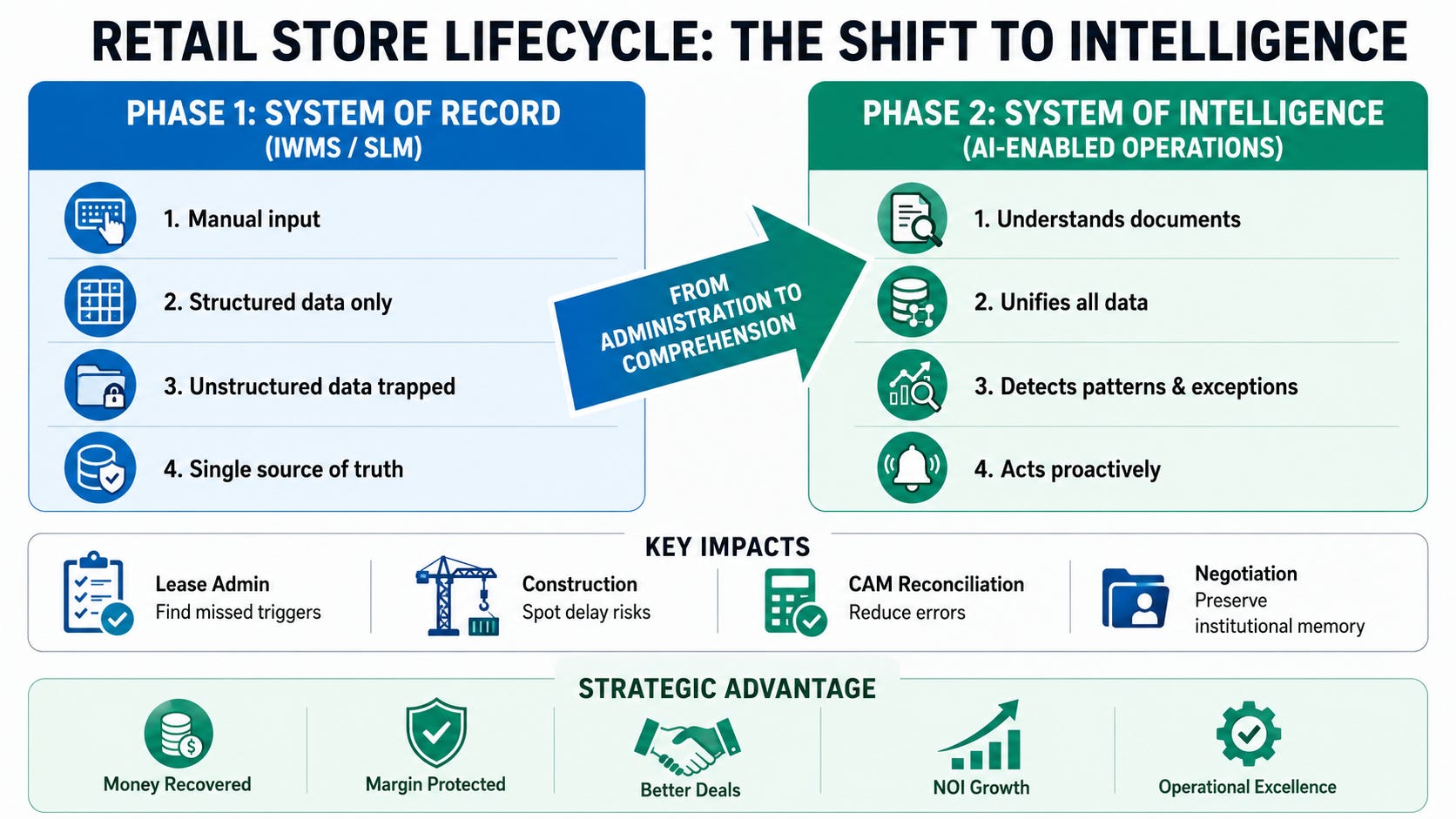
Lease administration has always been the discipline of knowing what a lease says and acting on it before the relevant window closes. The challenge is that retail leases are extraordinarily dense and complex documents, and the most valuable provisions — co-tenancy protections, kick-out rights, exclusivity clauses, radius restrictions, go-dark provisions, force majeure language — are precisely the ones most likely to be missed in the daily operational flow. These clauses represent negotiated economic value. A co-tenancy clause that permits rent reduction or early termination in response to an anchor closure may be worth hundreds of thousands of dollars over a portfolio’s life. But it is only worth that if someone notices the anchor has closed and knows to look.
An AI system that monitors news feeds, bankruptcy filings, public records, and sales performance data — cross-referenced against the relevant clause in every active lease — does not miss that signal. The clause doesn’t sit dormant until a lease administrator happens to notice a change in the tenant mix down the corridor. It activates. The retailer receives a specific, actionable alert: the contractual trigger has occurred, the window is open, here is precisely what the lease allows.
The same logic applies to construction and project management, where the risks are equally concrete. Construction agreements contain provisions governing delay penalties, change order caps, notice requirements, recovery rights, and substantial completion milestones — provisions with hard deadlines that can expire quietly if no one is watching. When project schedules, PM system data, budget revisions, RFIs, and contractor email threads are treated as a unified, AI-accessible corpus rather than siloed data streams, the system can detect in real time that a communication references a delay beyond a contractual milestone and that the notice requirement window is seven days, before that window closes. Instead of discovering missed rights during litigation or post-project audit, operations are protected prospectively.
Email deserves particular attention because it is where store lifecycle decisions actually happen — and where the signal-to-noise problem is most acute. Retail real estate directors, managers and Lease Administrators routinely manage inboxes in the hundreds of messages per day, with critical contractual signals embedded in the volume. A director of lease administration described recently receiving more than 500 emails on a given day, the majority of which fell into a handful of recognizable patterns: landlord correspondence, vendor escalations, contractor updates, notice letters, co-tenancy alerts. AI can be trained to detect, classify, prioritize, and route these communications with greater consistency than a human reviewing at speed, under pressure, while also managing the rest of their portfolio. An email that activates a contractual clause or triggers a notice requirement does not disappear because the relevant manager was traveling or reviewing something else. The intelligence is always present, and always reading.
In facilities management, the economics are equally direct. When work orders and vendor invoices are matched in real time against the repair and maintenance obligations specified in the corresponding lease, misattributed repair costs surface before they are paid rather than after. A roof membrane repair billed to the tenant that the lease assigns to the landlord becomes a flagged exception at the point of approval, not a dispute six months later. That is the difference between protecting NOI and recovering it.
CAM reconciliation, historically one of the most resource-intensive and error-prone functions in lease administration, presents one of the clearest near-term opportunities. Done correctly, it requires simultaneous access to ERP data, lease language, store lifecycle system entries, vendor invoices, and email clarifications — a cross-referencing exercise that strains even experienced teams. An AI-enabled system can extract the relevant CAM clauses, interpret applicable caps and exclusions, pull the corresponding ERP charges, and cross-check recoverable against non-recoverable costs in a fraction of the time currently required, while reducing the error rate that the industry currently absorbs at such considerable cost.
The Memory the Industry Has Been Losing
One of the most consequential — and least visible — applications of AI in retail real estate is the preservation and deployment of institutional negotiation knowledge.
Real estate managers negotiate hundreds of leases over the course of careers spanning decades. In that time, they develop nuanced, landlord-specific intelligence: which landlords routinely concede on CAM caps when renewal terms are extended, which markets support aggressive tenant improvement packages, which arguments have historically succeeded with which counterparties, and which concessions were granted quietly during periods of market softness. This knowledge is enormously valuable. It is also almost entirely personal. It lives in memory, in email archives, and in PDF redlines that no organization has time to systematically analyze and codify.
When key personnel retire, are recruited away, or simply move on, that intelligence leaves with them. The organization starts the next negotiation without the benefit of the last ten. This is not a soft problem. In one workplace knowledge study, 42% of institutional knowledge was found to be unique to the individual employee — meaning it was not shared by coworkers and became unavailable when that employee left, retired, or was otherwise unreachable. For a retail real estate organization, that lost knowledge is not generic know-how; it is negotiating leverage, market memory, landlord history, and economic advantage.
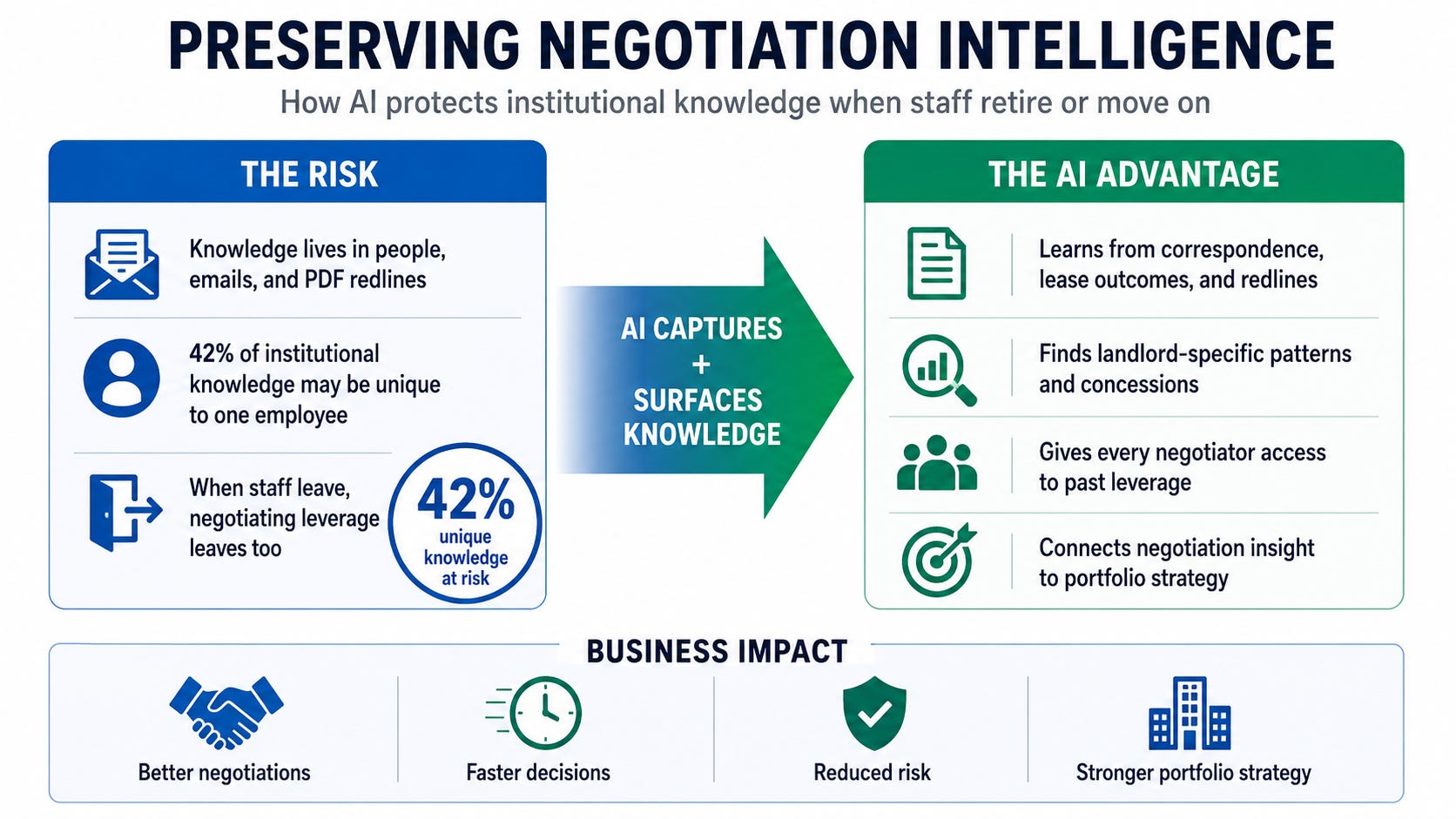
AI changes that calculus decisively. A system trained on decades of negotiation correspondence, lease outcomes, redlined drafts, and comparable market data can surface patterns that no individual negotiator would have time to identify manually: the landlord who consistently yields on HVAC responsibility language after a second request, the co-tenancy protection that has historically been accepted in initial drafts across a particular market, the concession pattern that appears reliably during lease renewals in markets with vacancy above a certain threshold. That becomes institutional leverage made accessible to every negotiator, in every market, on every deal — not dependent on who is sitting across the table or how long they have been with the company.
The same capability extends naturally to portfolio strategy. Because AI can reason across structured and unstructured data simultaneously, it can surface correlations that no conventional report would generate: stores with elevated facilities spend clustering in portfolios managed by landlords who also exhibit delays in TI reimbursements; projects that slip beyond specific milestone thresholds correlating with co-tenancy enforcement gaps; demographic softening in particular trade areas appearing in landlord correspondence months before it registers in traffic count reports. These cross-domain insights are the output of an intelligence layer, not a database query. They are available to leadership as a forward indicator, not a retrospective summary.
The Stakes for Executives
The commercial and competitive implications of this shift are not abstract. In an environment where store closures are accelerating, occupancy costs are under scrutiny, headcount is constrained, and margin compression is the operating condition rather than the exception, the hidden costs of dormant clauses, undetected CAM overcharges, missed construction contract rights, and email-driven oversights add up quickly and materially. The billions in annual friction costs that the industry currently absorbs from CAM-related errors alone represents NOI that belongs to retailers and is currently going elsewhere.
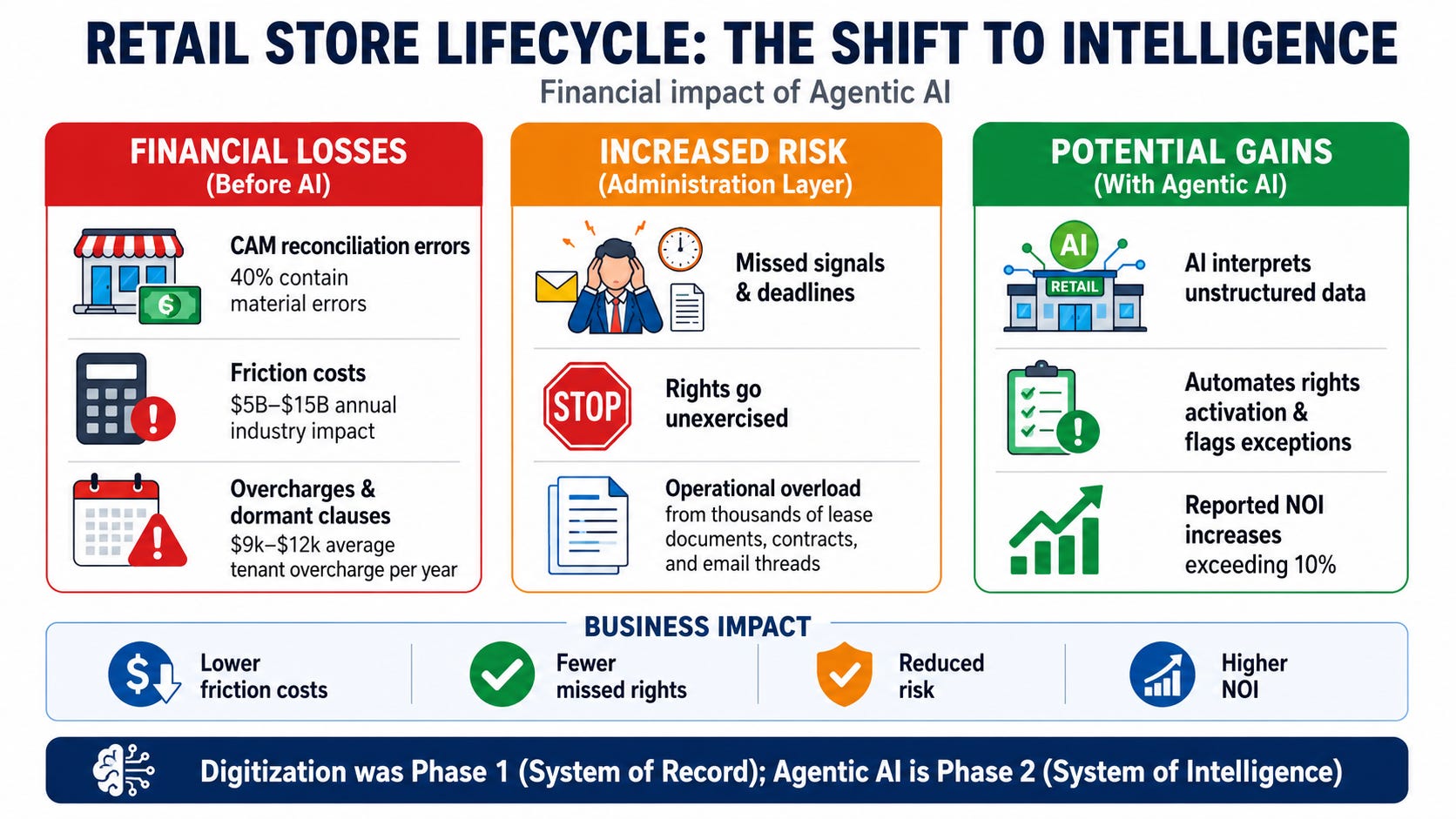
The deeper competitive implication is institutional. Retailers who adopt AI-enabled real estate operations early will not merely operate more efficiently — they will be better informed. They will negotiate from a position of institutional memory that their counterparties cannot easily replicate. They will activate contractual rights that peers don’t know they have. They will identify risk concentrations in their portfolios before those concentrations surface in quarterly earnings conversations. And they will do all of this without building larger teams — by making the teams they have substantially more capable.
A Generational Inflection
I spent the better part of two decades helping retailers build the systems that organized their operations. Those systems digitized retail real estate and delivered real value. They created the single source of truth that the industry needed, and that foundation matters enormously — it is the substrate on which the next layer is built, and it stays exactly where it is.
But digitization was Phase 1. What we built was a system of record — a place to store what was known and retrieve it accurately. What AI enables is a system of intelligence — a layer that sits on top of those systems of record, interprets what they store, connects it to everything else, monitors the entire corpus continuously, and applies reasoning to surface what would otherwise be invisible. It doesn’t replace the system of record; it depends on it, and makes it more valuable.
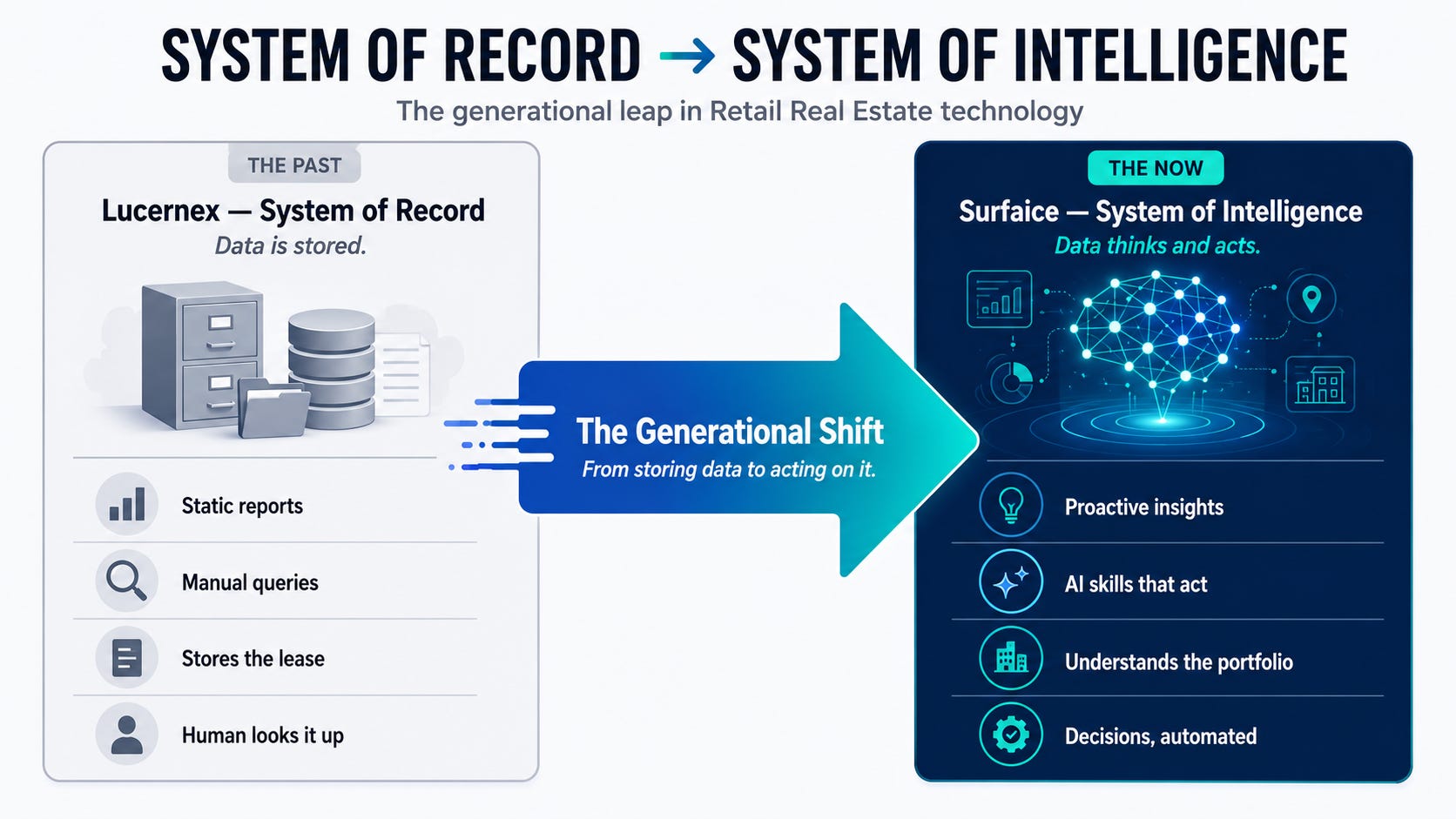
The distinction is not technical. It is strategic. Every lease clause that activates automatically rather than expiring dormant is money recovered. Every CAM error flagged before payment is margin protected. Every negotiation informed by institutional memory is a better deal. Every risk identified before it becomes an earnings surprise is a board conversation that doesn’t have to happen — and every one of those wins flows through the systems you’ve already invested in, not around them.
The retail real estate industry has never operated in a more demanding environment. It has also never had access to tools this capable. The organizations that recognize the nature of this inflection — that the goal is to finally extract the full return on the systems they already own — and move toward it with intention will define what operational excellence in retail real estate looks like for the next decade.
That opportunity is available right now. It will not wait indefinitely.

Alim Uderbekov, a briliant young astrophysicist and I are building Surfaice.pro to deliver on the promise of AI specifically for retail tenants. Much like Lucernex’s laser focus on Retailers (during my leadership), Surfaice understands that to truly deliver for the retail real estate market, we cannot get distracted or allow the product to be diluted by other markets and their needs. Surfaice is purpose built for retailers by retailers.
If you would like to see detailed case studies on portfolio optimization and CAPEX spend decision making using AI, please click below:
References
Grand View Research. Integrated Workplace Management System Market Size & Trends. 2024. https://www.grandviewresearch.com/industry-analysis/integrated-workplace-management-system-market
PredictAP. “The $15 Billion Problem Hiding in Plain Sight: Why 40% of CAM Reconciliations Contain Material Errors.” 2023. https://blog.predictap.com/the-15-billion-problem-hiding-in-plain-sight
Springbord. “How CAM Reconciliation Impacts Net Operating Income in Commercial Real Estate.” 2023. https://www.springbord.com/blog/how-cam-reconciliation-impacts-net-operating-income-in-commercial-real-estate/
Coresight Research. Store Tracker Extra: US Store Openings and Closures 2024 Review and 2025 Outlook. January 2025. https://coresight.com/research/store-tracker-extra-us-store-openings-and-closures-2024-review-and-2025-outlook/
Coresight Research. Store Tracker Extra: US Store Openings and Closures 2024 Review and 2025 Outlook. January 2025. https://coresight.com/research/store-tracker-extra-us-store-openings-and-closures-2024-review-and-2025-outlook/
JLL Research. Transforming Commercial Real Estate Through Artificial Intelligence. 2025. https://www.jll.com/en-us/insights/transforming-commercial-real-estate-through-artificial-intelligence; JLL Research. Artificial Intelligence — Implications for Real Estate. 2024. https://www.jll.com/en-us/insights/artificial-intelligence-and-its-implications-for-real-estate
Coresight Research. Store Tracker Extra: US Store Openings and Closures 2024 Review and 2025 Outlook. January 2025. https://coresight.com/research/store-tracker-extra-us-store-openings-and-closures-2024-review-and-2025-outlook/
Bisnow. “These 4 Newest Proptech Unicorns Show AI’s Increasing Role in Commercial Real Estate.” 2025. https://www.bisnow.com/national/news/proptech/the-4-newest-proptech-unicorns-show-ais-increasing-role-in-real-estate-133304; NAIOP. “AI’s Growing Impact on Commercial Real Estate.” Development Magazine, Winter 2024–2025. https://www.naiop.org/research-and-publications/magazine/2024/Winter-2024-2025/business-trends/ais-growing-impact-on-commercial-real-estate/